
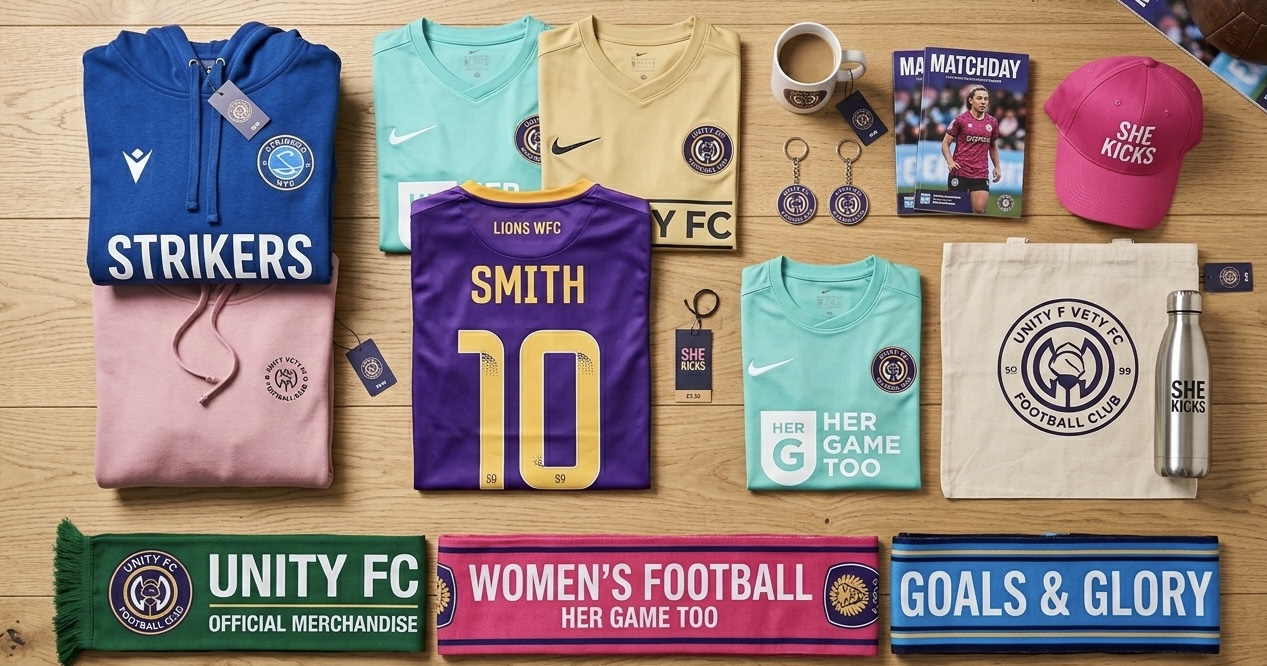
For too long, supporters of the women’s game were treated as an after-thought in the club shop. If you wanted to show your colours, you were often stuck with generic, ill-fitting unisex templates or “feminised” lifestyle apparel.
As we move through 2026, that era of compromise is finally ending. Driven by a surge in commercial investment and a more nuanced understanding of the female fan, the industry is shifting toward bespoke designs the prioritise the women’s game as one of the fastest-growing frontiers in global sports retail.
From “Bespoke” to “Standard”
The turning point began when kit manufacturers stopped treating the women’s game as a subset of the men’s. We’ve moved past the era where the only difference in a women’s kit was a V-neck and a tighter waist.
Today, brands like Nike, Adidas, and Puma are engineering performance wear based specifically on female needs. Clubs are increasingly launching standalone home and away designs for their women’s teams that allow the women’s side to build its own brand equity separate from the men’s team.
The Lifestyle Crossover: Football as Fashion
Perhaps the biggest growth area in 2026 isn’t on the pitch, but on the street. Women’s football stars are now the faces of luxury and high-street collaborations and merchandise is moving beyond the 90 minutes. We’re seeing “drop culture” hit women’s football:
- Limited edition capsules: Think oversized vintage-wash tees, varsity jackets, and streetwear that looks at home in a coffee shop, not just a terrace.
- The “M&S Effect”: Collaborative tailoring—like the Marks & Spencer x England collection—has proved that fans want to buy into the lifestyle of the athletes, not just their matchday uniforms.
The $3 Billion Business Case
The numbers back up the sentiment. Deloitte recently projected that global revenues for women’s elite sports will surpass $3 billion in 2026, with commercial revenue (including merchandising) making up a massive 45% of that pie.
Retailers are finally waking up to the fact that the women’s football audience is fiercely loyal and commercially underserved. During the 2025 Euros, children’s apparel revenue jumped by over 50%, proving that families are buying into the “Legacy” narrative. The “Business of Fandom” has realized that a fan is a fan, regardless of gender, and their money is just as green.
Closing the “Authenticity” Gap
For a long time, the lack of quality merch was a barrier to “authentic” fandom. If you can’t buy the goalkeeper’s jersey or a kit that fits, you feel less like a part of the club. Nothing illustrated this disconnect more starkly than the Nike and Mary Earps controversy. Despite Earps being the best in the world, the sportswear giant initially failed to produce her England goalkeeper kit for the 2023 World Cup, citing a “commercial strategy.”
The ensuing backlash (led by Earps herself and backed by 150,000 petition signatories) forced a high-profile U-turn. Nike eventually backtracked, releasing the shirts in limited runs that sold out in minutes. This was a watershed moment that proved the demand for women’s specialist gear was not just real, but massive. In 2026, we are finally seeing that lesson stick, with equal availability across many major club stores and a commitment from brands that no player (or fan) will be left out of the retail narrative again.
The Bottom Line
The rise of women’s football merch isn’t just about selling more shirts. It’s about visibility, respect, and recognizing a market that has been ignored for a century. As the “digital terrace” grows and the business of fandom evolves, the clubs that treat their women’s merchandise with the same creative and commercial weight as their men’s will be the ones that win the next generation of supporters.
Leave a Reply